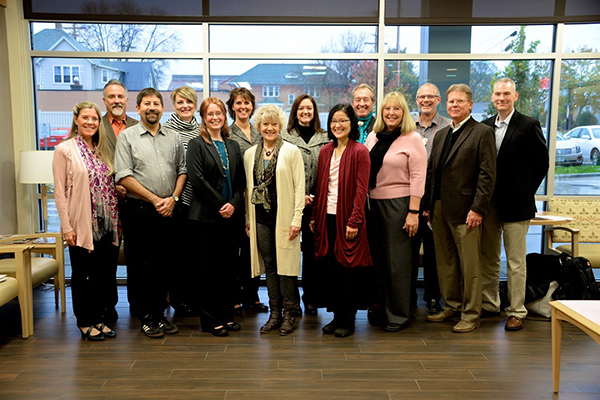
Key leaders from the Veterans Health Administration, PIRE, MicroAssist and UW-DFMCH met to discuss the next phase of the VHA whole health initiative. (Credit to Armando Vera for the photo)The new 2017 VHA contract, providing expanded course offerings for clinicians, increased evaluation and other new components, was marked by a kick-off meeting in Madison, Wisconsin this past fall to plan the implementation of the whole health initiative. The meeting was attended by PIRE Project Director, David Rychener, CEO Bernie Murphy, Center Director and Lead Evaluator, Bill Scarbrough, and Program Director, Ann Mason, along with Veterans Health Administration (VHA) leaders and PIRE’s partners from the University of Wisconsin Integrative Health and MicroAssist.
Whole Health’s First Steps
The whole health initiative aims to advance a “whole person” approach to health care—one in which health care teams partner with patients to look beyond traditional disease management and wellness approaches and work to co-create health and well-being.
The whole health approach encourages people to reflect on what matters most to them and how it relates to their health. It emphasizes self-care, prevention, and the evidence-informed use of conventional and complementary care. This broader lens supports the health care partnership, and aids patient healing and clinician fulfillment.
Milestones Achieved with Clinical and Coaching Courses
The courses and materials developed under the first VHA contract in 2013, and continued through the present contract, include the Whole Health Foundations Toolkit, Whole Health Coaching, and Whole Health: Change the Conversation.
As of December 2016, PIRE/UW teams have presented the Change the Conversation course 52 times to over 2,200 VHA clinicians nationwide. It is changing practice behaviors, according to an October 2016 article published in Family Medicine (https://www.ncbi.nlm.nih.gov/pubmed/?term=27740671). Under the leadership of Dr. Adam Rindfleisch, Medical Director for UW Integrative Health, the course has been recently modified and renamed Whole Health in Your Practice (WHYP). It will be offered an additional ten times in fiscal year 2017.
The Whole Health Coaching (WHC) course has been offered 30 times since 2013 and recently surpassed 1,000 graduates. Under the 2016 contract, the VA WHC course was approved as a transitional health coach program and close to 300 attendees have passed the practical skills assessment in their pursuit of health coach certification through the National Consortium of Health and Wellness Coaches.
The Whole Health Foundations Toolkit is available to all VA staff via the VA SharePoint site. The UW team also developed supplemental online material to help clinicians better understand and implement the whole health model. The peer-reviewed curriculum contains 35 evidence-based educational modules and over 200 point-of-care clinical tools. These and other PIRE/UW developed materials can be found at http://projects.hsl.wisc.edu/SERVICE/curriculum/index.html.
Advanced Courses Offered
Last year, the UW Integrative Health team developed and piloted two advanced whole health education programs for the VHA.
In one program, “Whole Health for Pain and Suffering: An Integrative Approach,” clinicians learn complementary approaches to pain care, including manual therapies, acupuncture, nutrition and mind-body techniques. They also reflect on their own whole health needs, which can help lessen their risk of burnout while caring for patients in pain. “Because of the widespread national concern around opioid use in the United States, this course has proven to be especially timely,” explains Adam Rindfleisch, MD, who leads the project for the UW. “Complementary and integrative health is specifically mentioned in the recently-passed Comprehensive Addiction and Recovery Act (https://www.congress.gov/bill/114th-congress/senate-bill/524/text) as a required part of clinical and educational initiatives related to opioid prescribing at the VHA.”
The other UW-developed program, “Personal Health Planning in Your Practice: Making It Real,” helps clinicians and teams understand the role of personal health planning in the co-creation of health and well-being and how to implement it in the clinical setting.
Project Director David Rychener, Ph.D. piloted a third advanced course last year. It was part of a new VHA initiative - Whole Health Pathways. In the Pathways model, seven “design” sites were selected to explore options for introducing Veterans to whole health. Dr. Rychener trained VHA staff, clinicians and Veteran volunteers from these 7 sites as Whole Health Group Facilitators to lead 9-week sessions for Veterans. Under the 2017 contract, eleven more sites were added to the Whole Health Pathways program and another six training sessions will be offered.
Three new advanced courses will be piloted this year as well. The UW will lead the effort along with subject matter experts from the VHA in developing a course focused on whole health and nutrition. The second course will be a collaborative effort between Dr. Rychener and Dr. Rindfleisch to develop a two-day course that highlights the key elements of the coaching and clinical courses. The third pilot will involve development of several delivery options for the Facilitated Groups program in use by the Whole Health Pathways sites.
Complementing all of the advanced courses is an online component developed in collaboration with MicroAssist and PIRE/UW. Four online courses were completed last year and additional courses are planned for this year. Eventually, all the courses will be available to the public via TRAIN (an online VA learning platform).
Evaluation is Critical Component to Contract Success
Louisville Center Staff (Bill Scarbrough, Kathy Atwood, Melissa Abadi and David Collins) are valued members of the PIRE team working on the VHA contract and involved in the evaluation of all educational offerings developed by PIRE and our subcontractors. Using the Kirkpatrick Four-Level Training Evaluation Model as a framework, and a pre-/post-/3-month follow-up measurement approach, each of the courses is evaluated for Level 1 (knowledge), Level 2 (satisfaction), and Level 3 (behavior) outcomes. Year 1 data is currently being analyzed and prepared for reporting. While the advanced courses and online courses are conducting evaluation, the largest effort is focused on the clinical (Change the Conversation), coaching and the Whole Health Facilitated Groups (WHFG) programs.
Preliminary findings for the Whole Health: Change the Conversation course outcomes (pre to immediate post at seven sites) show statistically significant increases in:
- Positive Attitudes towards Integrative Medicine (7 out of 7 sites);
- Intentions to Engage in WH Behaviors (7 out of 7 sites);
- Intentions to Discuss the Circle of Health (6 out of 7 sites);
- Self-Efficacy to Engage in WH Behaviors during clinical encounters (7 out of 7 sites);
- Preparedness to Engage in Discussions about Non-pharmaceutical Approaches to Care (6 out of 7 sites);
- Self-Efficacy to Discuss Components of the Circle of Health (5 out of 7 sites);
- Empathy (5 out 7 sites); and
- Mindful Awareness (2 out of 7 sites).
There were no statistically significant changes found for Burnout (1 site decreased pre to post, 1 site increased pre to post, no significant change at the other 5 sites). OPCC&CT wanted to increase the number of MD/DO providers attending the course and modifications were made early on in the year. Following this change, stratified analyses were conducted for MD vs. all other occupational roles. Findings for both groups were similar to the above.
Comparable to the Change the Conversation course, the Whole Health Coaching course also saw statistically significant increases in outcomes (pre to immediate post from four4 sites) in:
- Preparedness for Whole Health Coaching (4 out of 4 sites);
- Self-Efficacy to Use Whole Health Coaching Skills (4 out of 4 sites);
- Attitudes toward Patient Driven Care (3 out of 4 sites);
- Institutional Support for Patient Driven Care (2 of 4 sites).
The third program evaluated, and perhaps the most challenging, is the Whole Health Facilitated Groups (WHFG). In 2016, pre- and post-test surveys were administered at three trainings: Newark, New Jersey (March), Fort Worth, Texas (May), and Salisbury, North Carolina (August). The sample comprised 42 participants who completed the training at one of these sites. Participants ranged from VHA providers to Veteran volunteers. Courses were delivered at the Pathway Design Sites only and were led by either VHA staff or Veteran volunteers following their training. The challenge with this evaluation is the length of time between training and delivery of the first on-site program. Follow-up data was collected as facilitators completed their first facilitated group with Veterans and focus group data from the trainings is currently being coded. Participants report high satisfaction with the course, content quality, trainer quality, and course utility. Again, parallel to other courses, the WHFG also saw statistically significant increases in outcomes (Pre to Immediate Post from three sites) in:
- Preparedness to lead/ facilitate group session with peers (3 out of 3 sites);
- Knowledge of WH skills and tools (3 out of 3 sites);
- Self-efficacy to lead/ facilitate group session with peers using the tools and strategies in the training (3 out of 3 sites);
- Attitudes about the importance of group programs (1 out of 3 sites);
- Intentions (1 out of 3 sites).
With the distribution and collection of 90-day post course evaluations, final reports for the FY 2016 courses will be written and submitted to OPCC&CT.
Whole Health for the VHA’s Future
In October 2016, following the award of the Option Year 1 contract, VHA Office of Patient Centered Care and Cultural Transformation (OPCC&CT) Executive Director, Tracy Gaudet, MD, along with other representatives from the VHA and PIRE, visited the UW Department of Family Medicine and Community Health to talk more about how the whole health model represents a “radical redesign” in health care—and how the VHA is embracing this shift.
In her presentation https://www.youtube.com/watch?v=1jyxQPdPefw), she explained the ways the Whole Health model is currently being implemented at the VHA, and cited a New England Journal of Medicine article (https://www.ncbi.nlm.nih.gov/pubmed/26981931) affirming that the model is a key component of the VHA’s proposed future delivery system.
Dr. Gaudet emphasized that human care, self care and clinical care are equally critical to improving patient empowerment, Veteran satisfaction, access, outcomes and costs—and fostering trust. She also noted that the Whole Health approach extends into establishing relationships throughout the community.
“The role that we are together playing in creating that future is exciting,” she expressed.
Also in October, the directors of the 18 VHA networks across the U.S. initiated a bold plan to establish whole health demonstration sites in each region in fiscal year 2018. VHA OPCC&CT is actively developing the education plan to meet this expansion. PIRE and UW will continue to play a critical role in developing and delivering curriculum, and training representatives from these regions how to apply the whole health approach in their practices and personal lives. |


